
Opening structures
- Lid-and-base with a flush or overhanging edge
- Hinged lids with ribbon stop, chain or concealed hinges
- Sliding lids and sliding trays
- Drawer, book-style and clamshell constructions
Custom Solutions
How the box opens and how it is built — the two decisions that constrain everything else.
Structure is the first decision and the hardest to change later. It fixes how the box opens, how strong it is, how much it weighs and how much of the cost sits in the construction rather than the finish.
We work from the product's exact dimensions — including the small clearances that make a box feel engineered rather than approximate — and propose two or three structures that suit the price point before anything is drawn in detail.
The brief behind it
Every later decision depends on structure. Once the opening mechanism is fixed, the panels have known sizes, the interior has a known volume and the hardware list is known. Change the structure after the design is developed and most of that work is redone.
It is also where the money is. Two boxes with the same exterior dimensions can differ by a large factor in cost depending on the joint, the wall thickness and whether the lid is hinged or lift-off. That is why we price the structural options before spending time on finish.
The final input is the product itself: its weight, its centre of gravity, whether it has a protruding part, and whether it needs to be lifted out by fingers or tipped out. Those facts set the internal cavity, which then sets the exterior.
What you can specify
Every point below is developed with you and confirmed on a physical sample before production.
Send the product dimensions, an approximate quantity and the date you need it. We come back with structure, material and finish options — and a clear quotation.
Start a projectAt a glance
The five structures we use most, and the situation each one suits.
Why it matters
These are the choices this page decides. Getting them right at the sampling stage is what keeps cost and rework out of production.
Discuss your projectWho buys this
The same product is specified very differently depending on who is buying it. These are the briefs we see most often.
Common questions
Yes. Send the product dimensions or, better, the product itself. We design the internal cavity around it rather than starting from a standard box size.
Usually yes — hinges, stops and the fitting labour add cost. A lift-off lid is the cheapest structure; a hinged lid is chosen when the opening experience justifies it.
Some structures can, and it meaningfully reduces freight volume. The trade-off is assembly time at your end, so it depends on where the box is being filled.
Enough that it slides in without force and does not rattle. For most products that is a few millimetres on each side, adjusted for material thickness and finish.
Yes, up to a point. A thicker edge reads more solid, but past a certain point it only adds weight and cost. We show the difference on samples rather than describing it.
A well-made lid-and-base with a sharp edge and a good finish. Most of the perceived quality comes from the edge, the joints and the surface rather than the mechanism.
It can, but at a cost — drawings, samples and sometimes tooling are redone. That is why we settle structure first and finish later.
Related
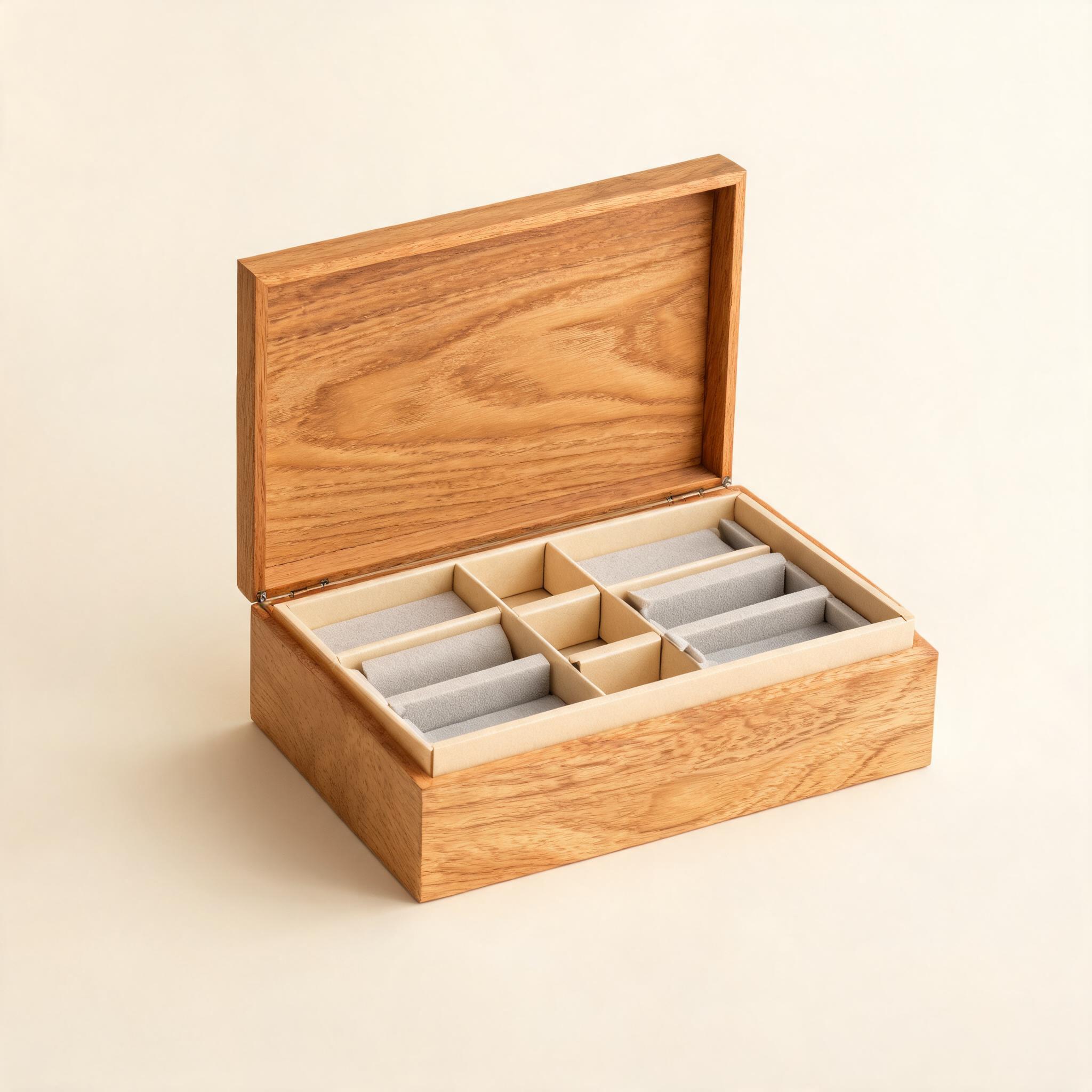
The inside is where the product is actually judged — and where transit damage is prevented.
Read more
The species sets the tone and the price; the finish decides how it feels and how long it lasts.
Read more
Showcase-grade boxes engineered so the product lands the moment the lid opens.
Read moreBack to the range
Send the brief — we'll come back with structure, material and finish options for size & structure, plus a clear quotation.